How an Employer of Record assumes legal liability abroad
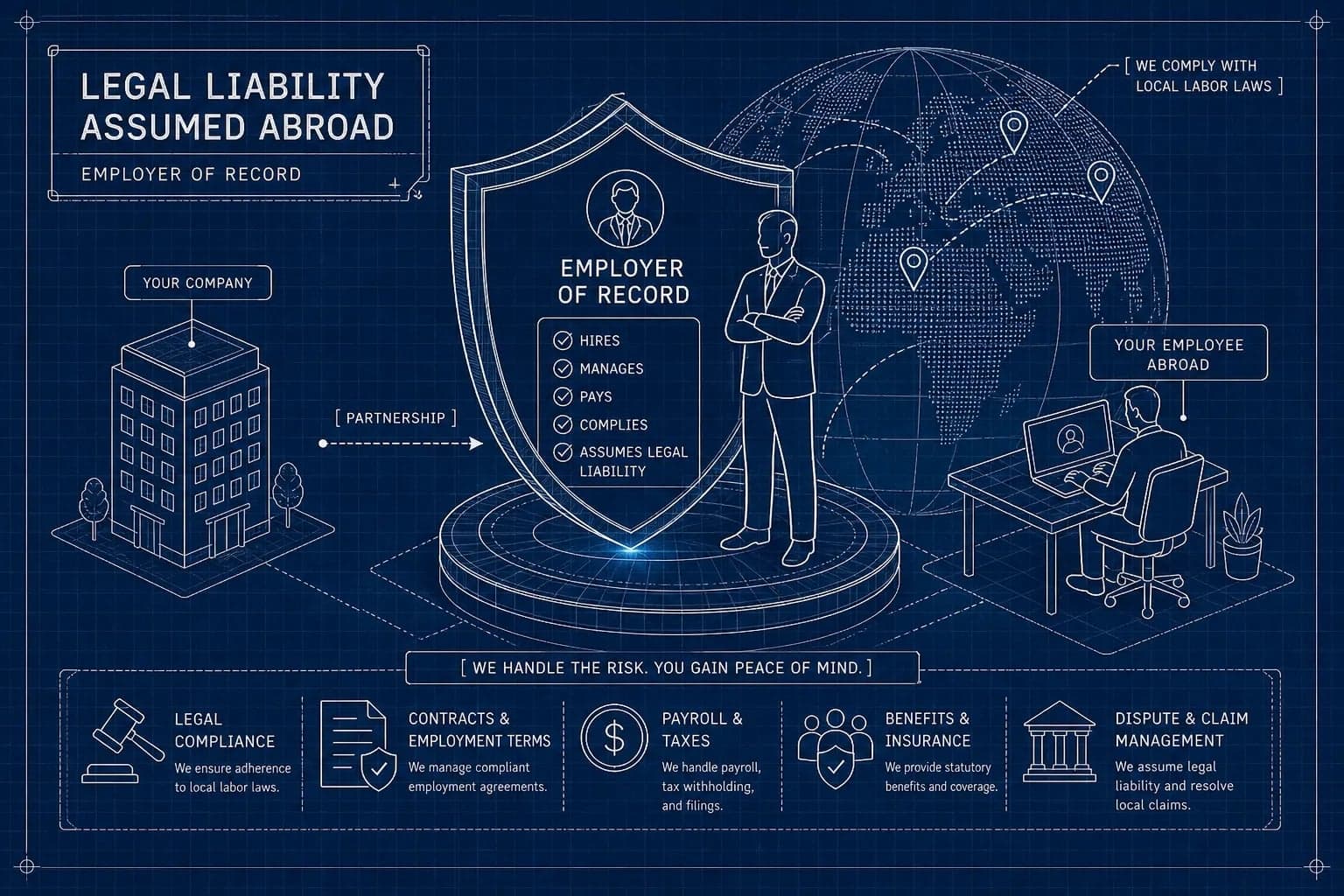
It is often assumed that hiring someone in another country simply means sending an offer letter and sorting out the pay. The legal reality is far more complex, and getting it wrong can expose your business to fines, back-tax claims, and employee disputes that drag on for years. Understanding how an employer of record assumes legal liability for employees abroad is the starting point for any compliant international hiring strategy.
An Employer of Record (EOR) solves this by becoming the legal employer for your overseas staff, taking on the full weight of local employment law so you don’t have to. Providers like AgileHRO operate across more than 150 countries, with dedicated human compliance specialists managing every layer, local contracts, statutory contributions, and everything in between. This article breaks down exactly how that legal transfer of responsibility works and what it means for your exposure as the client company.
How an EOR legally becomes the employer of record abroad
The EOR doesn’t simply process payroll on your behalf. It assumes a legally defined employer role through a regulated sequence of steps, each of which is necessary before it can employ anyone on your behalf in a given country.
The first requirement is a lawful local presence. The EOR must hold a registered legal entity, licensed branch, or authorised affiliate in the target country. Signing a contract and processing payments isn’t enough. Countries such as Germany regulate this specifically as employee leasing under the Arbeitnehmerüberlassungsgesetz (AÜG), requiring a dedicated operating licence and compliance with strict assignment-duration and equal-pay rules. The EOR’s local entity is what gives it the legal authority to employ; without it, the arrangement can be challenged or reclassified entirely.
Once that local presence is established, the EOR issues a locally compliant employment contract that names it as the employer, not your company. That contract must include mandatory local terms: pay, working hours, leave entitlements, probation rules, notice periods, and termination conditions. Before the worker’s first day, the EOR registers them with the relevant tax, social-security, pension, and insurance authorities. It sets up payroll in the correct currency, applies the correct withholding rates, and establishes the full schedule of employer contributions. Registration requirements and precise timing vary by jurisdiction, in many countries registrations must be completed before the first day of employment, while others permit completion within statutory deadlines, so confirming the exact sequence with local counsel and your EOR’s country matrix is advisable.
Which employment obligations shift to the EOR
Once established as the legal employer, the EOR assumes a broad set of ongoing statutory duties. Understanding precisely which obligations transfer is essential before you sign anything, because the scope is wider than most clients expect.
On payroll and tax, the EOR calculates gross-to-net pay, withholds employee income tax, remits employer and employee social-security contributions, issues payslips, and files periodic payroll returns. It handles mandatory statutory deductions such as National Insurance in the UK, INSS in Brazil, and IMSS contributions in Mexico. Where the EOR is responsible for payroll administration, errors in calculations or late remittances are typically allocated to the EOR under the services agreement, though the precise contractual allocation and local-law rules mean clients should ensure the indemnity provisions in their agreement reflect this clearly, particularly where inaccurate data has been provided by the client side.
Beyond payroll, the EOR enrols employees in mandatory benefit schemes, administers statutory leave including annual, sick, and parental entitlements, ensures compliance with working-time rules, and maintains all required employment records. It also handles right-to-work checks, onboarding documentation, and any legally required employment reporting specific to that country. In Brazil, this includes managing the FGTS housing fund and the 13th-month salary; in Mexico, it extends to profit-sharing (PTU), aguinaldo, and INFONAVIT contributions.
Termination is a shared process with a clear division of roles. The client provides the business rationale; the EOR assesses whether the action is lawful locally, advises on required consultation or notice periods, calculates final pay and accrued leave, and manages all statutory filings and documentation. You should not proceed with a termination without involving the EOR first; depending on the country and the terms of your services agreement, unilateral action may expose the client company to significant liability under local law.
How liability is split between you and the EOR
The EOR carries responsibility for employment compliance; the client carries responsibility for the business decisions that drive the employment. That distinction matters considerably in a dispute, and the services agreement must reflect it precisely.
The EOR’s liability covers payroll errors, incorrect tax withholding, statutory underpayments, unlawful contract terms, failure to administer benefits correctly, and any compliance failures in termination procedures. A well-structured agreement requires the EOR to indemnify you for penalties, back pay, interest, and defence costs arising from those failures. It should also bear liability for data breaches within its systems and for the acts of any local subcontractors it uses.
Your liability as the client remains tied to the instructions you give. If you direct a termination that the EOR flags as legally risky and you proceed anyway, the resulting liability shifts to you. You also remain accountable for workplace conduct your managers control, harassment, unsafe working conditions, or unlawful supervision, and for any inaccurate compensation or worker information you provide. The services agreement must specify these boundaries clearly. A vague “arising out of services” indemnity can shift EOR compliance failures onto you improperly, which is exactly the outcome you are trying to avoid by using an EOR in the first place.
On liability caps, market guidance commonly suggests requiring a general cap of 12 to 24 months of fees paid, with fraud, gross negligence, payroll errors, unpaid wages, statutory penalties, and data breaches explicitly excluded from that ceiling or placed under a materially higher dedicated cap. A fee-only cap that covers catastrophic payroll or employment-law failures offers little real protection.
Co-employment risk varies significantly by country
The EOR model is not identical everywhere. Local law determines whether third-party employment creates automatic joint liability, regulated employee leasing, or a straightforward outsourcing arrangement, and the answers vary significantly across markets.
In the UK, the EOR is generally recognised as the employer, but under the Agency Workers Regulations, equal-treatment rights can apply after 12 weeks if the arrangement resembles a worker-supply structure. Employment tribunals may also look past the contractual form if the client exercises substantial operational control. Germany is the most structurally regulated market: the AÜG classifies most EOR arrangements as employee leasing, requires a federal operating licence, limits assignments to 18 consecutive months, and mandates equal-treatment rights for leased workers. Operating without the correct licence can result in the worker being reclassified directly as the client’s own employee by operation of law.
Brazil and Mexico carry higher joint-liability risk. Under Brazilian labour law, courts may impose subsidiary liability on the client company for unpaid labour obligations if the EOR defaults, even where the contract is correctly structured. Mexico is the clearest case: following the 2021 outsourcing reform, the beneficiary of services can be pursued directly for wages, profit-sharing, and social-security obligations if the EOR fails to comply or lacks the required REPSE registration. In both markets, verifying the EOR’s compliance record and local registrations before onboarding is essential, contractual allocation of liability does not defeat mandatory statutory claims once they arise.
EOR vs PEO: why the distinction matters for legal exposure
These two models are frequently confused, but they create very different liability positions for your company. Understanding the difference is particularly relevant if you are expanding into markets where you already have a local entity.
An EOR is the worker’s formal employer. It signs the employment contract, runs payroll, and bears the primary employment-law liability for compliance obligations. Your company directs the worker’s daily output but generally avoids direct employer liability for payroll errors, statutory underpayments, and wrongful termination arising from the EOR’s administration. A Professional Employer Organisation (PEO), by contrast, operates as a co-employer alongside your existing local entity. You remain the legal employer, the PEO handles certain HR and payroll administration functions, and liability for employment-law failures is shared rather than transferred. A PEO typically requires your company to have its own registered entity in the country; an EOR does not.
This means an EOR arrangement is the appropriate structure when your company has no local entity and wants to hire compliantly without setting one up. If you misapply a PEO model in a market where you lack a registered entity, you may find yourself without a legally valid employer of record, leaving compliance obligations unallocated and your business directly exposed. A PEO may be appropriate where you are already established locally and want to outsource HR administration, but you must accept that your legal exposure as employer remains intact.
Due diligence before you sign anything
The difference between a compliant EOR arrangement and a costly liability often comes down to the checks you run before the contract is signed. A credible provider will make this process straightforward; one that resists disclosure is a material risk in itself.
Start by requesting the EOR’s legal entity name, registration number, tax ID, and registered address for every country where you plan to hire. Ask for a written country matrix that identifies whether the EOR uses its own entity, a licensed affiliate, or a third-party local partner, and confirm who bears employer liability in each case.
- Country-by-country legal entity and registration evidence, verified against government registries where available
- Partner disclosures and vetting procedures for any jurisdiction where the EOR does not use its own entity
- Sample local employment contracts, payroll SLAs, and recent compliance audit findings
- Insurance certificates covering employment-practices liability, professional indemnity, cyber, and employer’s liability
- A signed data processing agreement covering subprocessors, data residency, breach notification, and audit rights
- A services agreement with clear compliance warranties, indemnities tied to control and fault, audit rights, and a liability cap with proper carve-outs
Request sample local employment agreements and evidence of timely statutory remittances. Have local counsel review any structure that involves a third-party partner, particularly in Germany, Brazil, or Mexico. A provider that refuses to identify the actual legal employer or disclose its local partners represents a serious onboarding risk. The entire value of an EOR arrangement rests on the provider genuinely holding employer status in each jurisdiction. If that status cannot be demonstrated with documentation, the protection you are paying for may not exist in practice.
Getting the structure right from the start
Hiring abroad compliantly is not simply a paperwork exercise. It requires a legally authorised entity in the target country, employment contracts that hold up under local law, accurate payroll and tax remittances, and a services agreement that allocates liability precisely. The EOR model is built to carry that weight, but only if the provider is properly established in each jurisdiction and the contract is structured to reflect who controls what.
AgileHRO provides that legal infrastructure alongside dedicated human specialists who know the compliance landscape across its operating markets, covering EOR, global payroll, and international mobility within a single platform. If you are planning to hire abroad and want to understand how an employer of record assumes legal liability for employees in your specific target countries, contact the team directly to model the costs and structure before committing to anything.